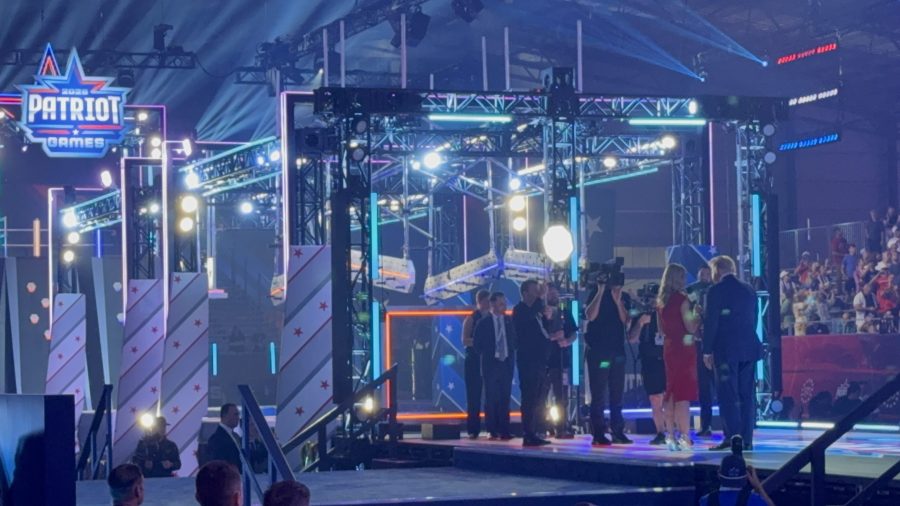
Ashtabula County does not get many nationally televised events. We get lake effect snow, we get the grape harvest, we get a good high school football rivalry in the fall. So when word came that the 2026 Patriot Games would be held at SPIRE Academy in Geneva, it registered as something genuinely unusual — and for a lot of us, something that happened ten or fifteen minutes from the driveway.
Worth noting up front: this event was originally slated for Washington, D.C. Organizers went looking for a venue that could handle a multi-sport national competition and a live television production at the same time, and they landed here. Not in a major metro. Here.
Our family ended up closer to it than we expected. We were on campus opening night with a level of access most attendees didn’t have — we walked the SPIRE facilities and saw how they’d been converted for the athletes, watched part of the dodgeball and kickball competitions, got a look at a fair amount of the behind-the-scenes operation, and ate dinner in the room with the competitors themselves.
Opening night
The competition ran August 9 through 11, but athletes started arriving in the Geneva area on the 7th and 8th. Opening night was built around a dinner for the competitors and their families — roughly 120 kids between 14 and 17, in from all fifty states, the U.S. territories, and tribal nations, most of them meeting each other for the first time.
What struck me was how ordinary it felt. These were teenagers a long way from home, eating dinner in an unfamiliar building in a county most of them had never heard of, doing the thing teenagers do when they’re nervous: sticking close to whoever they’d met first, checking their phones, laughing a little too loud. Some parents stood along the walls the way parents do – others sat at the tables of the Spire cafeteria/dining area alongside the athletes. It could have been any tournament banquet in America, except the license plates in the lot came from everywhere.
After a brief talk from one of the event organizers, the National Anthem was performed that night for those on-hand. Not a big, flashy production on a stage with a big sound system. Instead it was performed by a local Ashtabula County high school athlete and musician, Elizabeth Jernigan, and the response from the athletes was immediate and unforced — the kind of reaction nobody can stage. After loud applause came even louder chants of “USA! USA!” The feeling in that room was pro-America. Not pro-right, not pro-left. A few hundred people who were glad to be American and just enjoying the experience of it all – truly what this event felt like it should be. And I say that knowing full well that most national outlets will file this event under whichever narrative they arrived with. That’s the business now. But I was in the room, and what I saw was simpler than what it’s being made into.
What was actually assembled
Then you walked into the competition venue and understood the scale of what had been assembled.
This is where SPIRE’s size stops being a statistic and starts being the whole reason the event worked. A three-day competition with 120 athletes and a live television production needs more than one room. It needs several purpose-built spaces running at once, close enough together that kids can move between them on foot, with locker rooms, training space, dining and beds attached. There are not many places in the country that can do that. There is one in Ashtabula County.
The events themselves drew from a mix of sources — challenges modeled on the old Presidential Fitness Test, a military-inspired boot camp circuit, an obstacle course, plus team events including tug of war, kickball, dodgeball and a basketball shooting challenge. Elements of track and field, basketball, soccer and football were all in the mix. It rewarded the most complete all-around athlete rather than a specialist, and each of those disciplines needed a different kind of floor under it.
The team events ran on the basketball and volleyball courts. Tug of war and dodgeball were both contested there — the same hardwood that hosts tournaments and leagues most weekends of the year, cleared and re-striped for a national television production. Kickball took place out on the football field where Geneva and St. John have played their home games over the past several years.
The soccer fields drew the biggest single build. That is where they filmed the obstacle course that streamed on ESPN+, a circuit that ran athletes through a football toss, a soccer kick, a balance beam and a series of agility drills. It is a genuinely odd thing to stand on a soccer complex in Harpersfield Township and watch a network-grade course being run across it.
The centerpiece was the indoor football and track stadium, and that is where the whole thing built toward. They had turned it into a television set. Truss and lighting grids overhead, LED walls, a rope-and-net obstacle rig, spark machines, camera positions on jibs and gimbals. The production value was on par with anything you’d see from a network event. My immediate reaction was that I was standing at a live American Ninja Warrior course. Whatever anyone thinks about the concept, the execution was not amateur hour. Somebody spent real money and real expertise building it, and it showed.
That building is where Tuesday night happened. It is where the finals were run, where the medals were awarded, and where the President walked the track on his way in — every photograph anyone saw from that night, ours included, was taken inside a stadium in Harpersfield Township.
Tuesday – The Finals
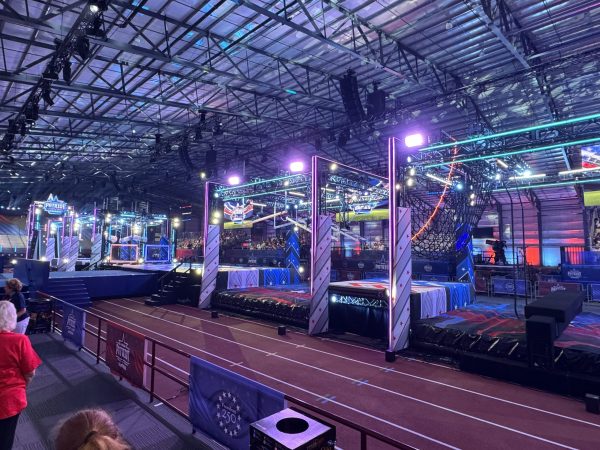 The finals were Tuesday, August 11. This is what the nation saw on ABC later in the week. The field had narrowed from four to the last two on each side — two young men and two young women, going head to head for a $250,000 scholarship pool split between one male and one female champion, $125,000 each.
President Trump attended. He flew into Cleveland Hopkins, came in by helicopter, and entered the arena walking the track alongside ESPN’s Pat McAfee, with the finalists behind them and the spark machines going. Before he took a front-row seat for the final events he passed right in front of where I was standing, maybe five yards away. No matter your political thoughts, it was an incredible experience to see the President of the United States just feet away. He stood for the National Anthem, was interviewed at “halftime,” and presented the trophies and scholarships afterward.
Plenty of people have opinions about a sitting president attending a youth sports event, and this article isn’t going to change any of them. What I’ll say is what I saw: the room was loud, the kids were thrilled, and the arrival was staged the way any major sporting event stages an arrival.
The competition itself was good. Kennadi Fuhrman of Kansas took the girls’ title, edging Kendall Baker from Michigan. Fuhrman is a senior soccer player and powerlifter out of De Soto High School. On the boys’ side, Rockwell Myers of Utah — a competitive rock climber and ballroom dancer, which is a combination I did not expect to type — won out over Max Biondolillo from Florida.
About the field
Here’s the part that deserves a fair hearing locally, because it’s been the most common criticism and I think it’s aimed in the wrong direction.
The Patriot Games were promoted as bringing together outstanding young athletes representing every state. A lot of people took that to mean the single best athlete in each state. It didn’t, and structurally it was never going to.
Athletes weren’t nominated by state athletic associations, ranked by performance, or drawn from any existing competitive pipeline. They applied. The process ran through the Freedom 250 portal: an online form confirming eligibility — age 14 by June 1, 2026 and no older than 17 by year’s end, U.S. citizen, resident of a state, territory or tribal nation, good academic standing, parental consent — plus a personal essay and a short video explaining who they were and why they wanted to compete. A selection committee reviewed the submissions, ran follow-up screening and verification, and chose the field.
So the field reflected who applied. That’s it. If the best sprinter in Nebraska never heard about it, or heard about it and had a travel ball commitment that week, or looked at it and decided it wasn’t for her, she wasn’t in the pool to be selected from. You cannot pick a great athlete who didn’t submit a video.
That’s not a failure of the organizers. It’s what happens with any first-year event recruiting by open application on a compressed timeline. The people running it could only choose from what came in. Judging the competition against the standard of “were these the fifty best athletes in America” is judging it against something it never claimed to be.
What the field actually was: 120 kids who wanted it badly enough to make a video about it. There are worse selection criteria.
About SPIRE
For readers outside the county — and honestly, for plenty inside it who have driven past the exit for fifteen years without stopping — SPIRE is worth understanding, because it is the reason this event came here at all.
SPIRE Academy sits on more than 800 acres in Harpersfield Township, just outside Geneva, with over 850,000 square feet of facilities under roof. It opened in 2009 and holds designation as an Olympic and Paralympic Training Site.
The facilities are the pitch:
- **Aquatics.** Two Myrtha pools built with input from USA Swimming, both configured for ten lanes of 50-meter racing and convertible to 25-yard or 25-meter courses, plus springboard diving.
- **Indoor arena.** A roughly 70,000-square-meter indoor complex hosting track and field, basketball and tournament events — the space the Patriot Games took over.
- **Outdoor stadium.** Seating for more than 10,000.
- **Fields and courts.** Over 207,000 square feet for basketball, volleyball, soccer and lacrosse.
- **Performance Training Center** and the SPIRE Performance Research Institute, which works in biomechanics, sports medicine, physiotherapy, rehabilitation and sports psychology, with a Cleveland Clinic affiliation.
- **Academics.** More than 25,000 square feet of classrooms and labs, plus an esports center. SPIRE operates as a fully accredited college-preparatory high school alongside the athletics.
- **On-campus lodging and dining**, which is the piece that makes hosting a multi-day national event possible in a rural county.
It is not only a boarding academy. SPIRE runs summer camps in basketball, soccer, swimming, track and field, volleyball and wrestling; youth and adult leagues including soccer and flag football; clubs for wrestling, volleyball and pickleball; a fitness center open to the public; and banquet and corporate outing space. If you live in this county and have a kid in sports, or just want a lane to swim in, there is a good chance there’s a program there you didn’t know about.
Address is 5201 SPIRE Circle, Geneva. Their site is spireacademy.com.
What it meant for the county
This is the part local readers should care about most.
Hosting the Patriot Games required Ashtabula County, Harpersfield Township and the City of Geneva to put real resources behind it. Local government dedicated resources to improving the surroundings. Hundreds of volunteers signed up. A few thousand spectators came through, many of them from outside the county, and they slept, ate, filled tanks and bought things while they were here.
That matters in a place with our economy. A hundred and twenty athletes brought families with them. Media brought crews. ESPN hired out a local Geneva-on-the-Lake company to feed their crews. A national broadcast put the words “Geneva, Ohio” in front of an audience that has never had a reason to think about us — and SPIRE landed a Good Morning America segment on top of it. You cannot buy that kind of exposure, and if you tried, the invoice would be well past what this county spends on tourism promotion in a decade.
We are already a destination county whether we act like one or not. Geneva-on-the-Lake, the wineries, the covered bridges, the lakefront — the assets are here. What we historically lack is a reason for people outside the region to make the first trip. Events like this create that reason, and the people who came for three days of competition drove past every one of those assets on the way in.
The practical question for our business community is whether we treat this as a one-time novelty or as proof of concept. SPIRE demonstrated it can host a national event at broadcast scale. The county demonstrated it can staff and support one. Those are the two hard parts, and both are now established fact rather than a sales pitch. Whoever is pitching the next event — and there should be a next event — gets to point at August 2026 as evidence.
What we took from it
The finale aired as a primetime special on ABC two days later. Watching it at home, the parts I recognized were smaller than the parts I didn’t, which is how television works.
What stayed with me wasn’t the broadcast. It was opening night, a room full of teenagers from everywhere, and Tuesday, a room full of strangers cheering for each other’s children. Our corner of Ohio hosted something the whole country watched, and it went off well. The kids who came here were treated like it mattered, and the county showed up for them.
For a place that mostly makes the news for the weather, that was a good week.